
The official resource page of the Profan research programme has finally been released!
Indeed, during my PhD, I had the opportunity to participate in the ProFan project, a large experimental research programme in psychology and education. This project was funded by two French ministries (MENJS and MESRI) and investigated the impact of alternative learning methods on development of social skills and academic performance among vocational students. Of particular interest for my PhD was whether cognitive factors (i.e. working memory capacity) and psychosocial factors (i.e., self-esteem, achievement goals) were likely to play a role during resource-dependent cooperation.
A full summary of my work and a video recording of my PhD defence are now available (in French) on the e-fran platform.
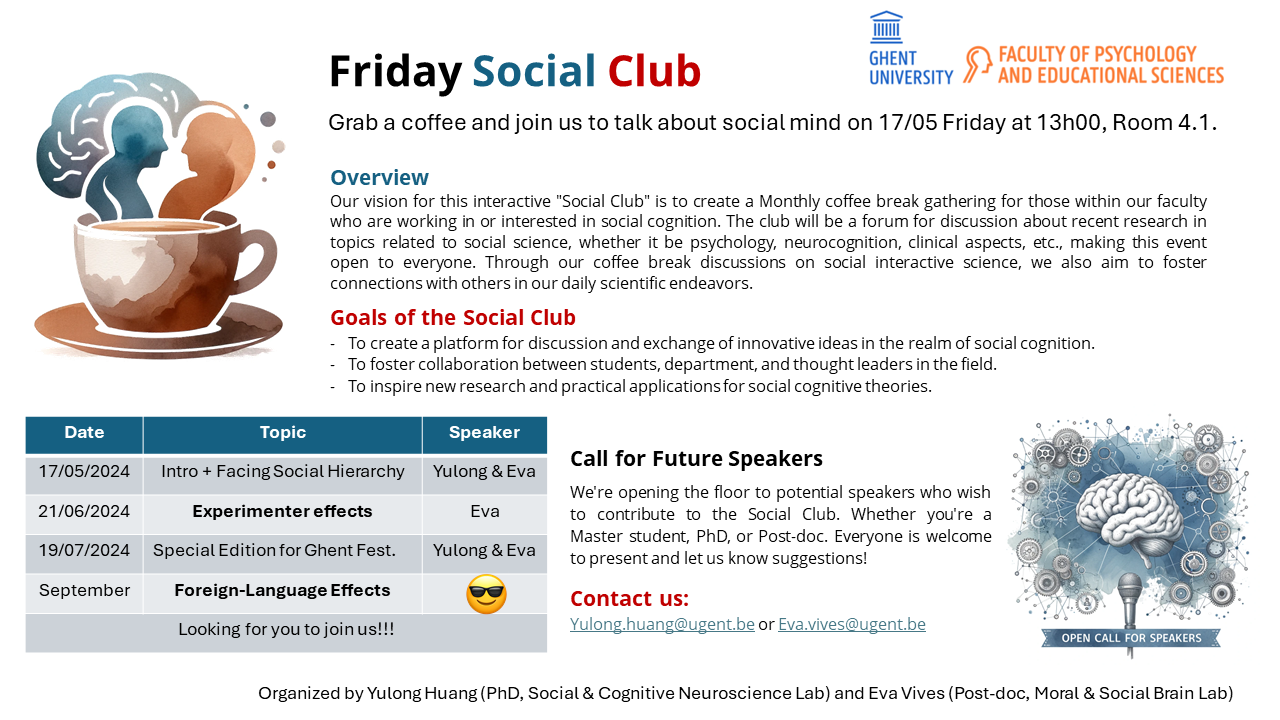
A few days ago, my friend Yulong Huang, PhD at UGent came to me with this idea: What if we organised a scientific and social event in our department to share thoughts, results and ideas about research in social cognition ? 1, 2, 3, on Monday the invitation letter was sent to the department!

Le MOOC « La Psychologie pour les enseignants » a suscité avant même sa diffusion un très fort engouement de la part de la communauté des enseignants, pédagogues, et formateurs en France. Les contenus riches proposés par ce cours en ligne (MOOC) sont suivis par des centaines de personnes chaque semaine. Sous l’égide de l’ENS et du Réseau Canopé, le MOOC aborde en trois grands chapitres, trois clefs de voute des apprentissages : les notions de mémoire, de punition/récompense et de motivation en milieu scolaire. Avec autant d’informations désormais en accès libre sur les bonnes pratiques d’enseignement, plus question d’ignorer l’architecture cognitive des élèves ou de se laisser submerger par un comportement perturbateur en classe.
This is a slightly unusual post, that has been close to my heart for a long time.
As both a researcher and an internet user, data privacy and data storage have become increasingly crucial over the years. This concern is not only about protecting my own data (never forget: your online data are valuable), but also about ensuring the safety and confidentiality of research participants and collaborators.
There is no such world where you have ‘nothing to hide’, because our world is constantly changing, both culturally and politically. Spread the word.
Without commenting further on the current global situation, I simply wanted to share a few practical solutions that can help maintain at least some control over personal data.
⚠️ This list is of course non exhaustive as I am not an IT engineer and because everyone must consider which practices and tools are best for their own situation. My idea is to provide suggestions that might be useful or inspiring for your own setup. This post is a living document, intended to evolve over the years. Feedback and additional suggestions are very welcome
Communication Tools
🛡️ iPhone iMessage
One of the messaging services with very limited governmental access
Designed and controlled by Apple
Blocking iMessage would require blocking entire telecommunications systems, making it practically infeasible
🛡️ Email — Proton Mail
Strong focus on privacy and encryption
Allows the creation of temporary security keys when sending emails to non-Proton users (e.g., Gmail)
Example:
You send an email from Proton to a Gmail address
The recipient receives a secure link
The message is opened directly on Proton’s servers, not Google’s
🛡️ Instant Messaging
Olvid (Highly Recommended)
Unlike WhatsApp, Telegram, or Signal:
Each conversation establishes a direct link between users
No reliance on a centralized server nor cloud
Strong identity-based cryptography
Signal (Fallback Option)
Preferable to Meta-owned services
Important note:
Not linked to a phone number
Smaller ecosystem and better privacy guarantees than most mainstream alternatives
🛡️ Data Storage
Personal NAS (Network Attached Storage)
Strongly recommended for:
Personal file storage
Photos and videos
Secure file sharing
Advantages:
Full control over your data
No third-party cloud dependency
Can be set up in half a day
Final Thoughts
Privacy-respecting tools are not about paranoia, they are about responsibility, especially in research contexts. Small choices, when combined, can significantly reduce unnecessary data exposure.
