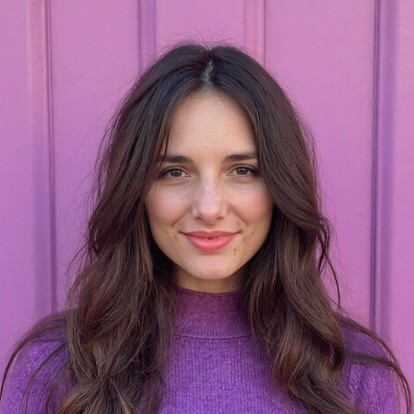
I am delighted to announce that my project entitled YourMorals - The role of social presence on moral decision-making: realistic settings for the understanding of utilitarian and deontological preferences has been accepted for a 2-year funding Marie Curie Postdoctoral Fellowship with excellent evaluation.
This research project emerged a few years ago while I was working on the impact of emotions on moral dilemmas with Yousri Marzouki and Olivier Oullier. Since then, I never stopped thinking that psychologists should consider social context a bit more to get a better picture of the processes associated with moral decision-making - because yes, moral choices are rarely made out of the social arena. Beyond any doubt, this project is the cornerstone of a larger program of research I expect to establish in the next years.
I am so grateful to start this position in one of the top-ranking universities in Europe, alongside an incredible supevisor, Prof. Emilie Caspar. More about my project is coming on this page. So let’s keep in touch !
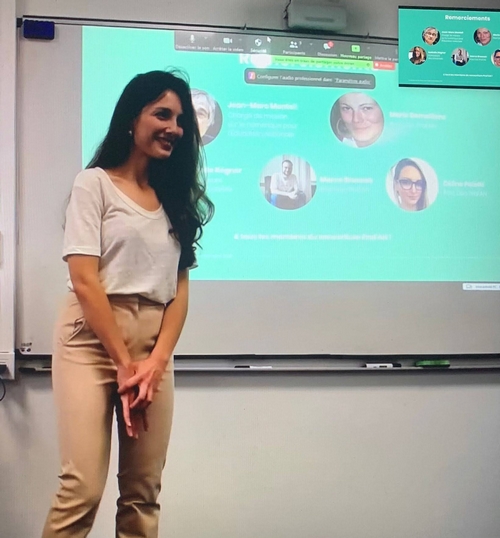
One year ago, on November 19th 2021, I defended my Ph.D. thesis at Aix-Marseille University, entitled ‘Cognitive and psychosocial mechanisms involved in Jigsaw cooperative learning : experimental studies in educational settings’, under supervision of Prof. Isabelle Régner. This day was amazing !
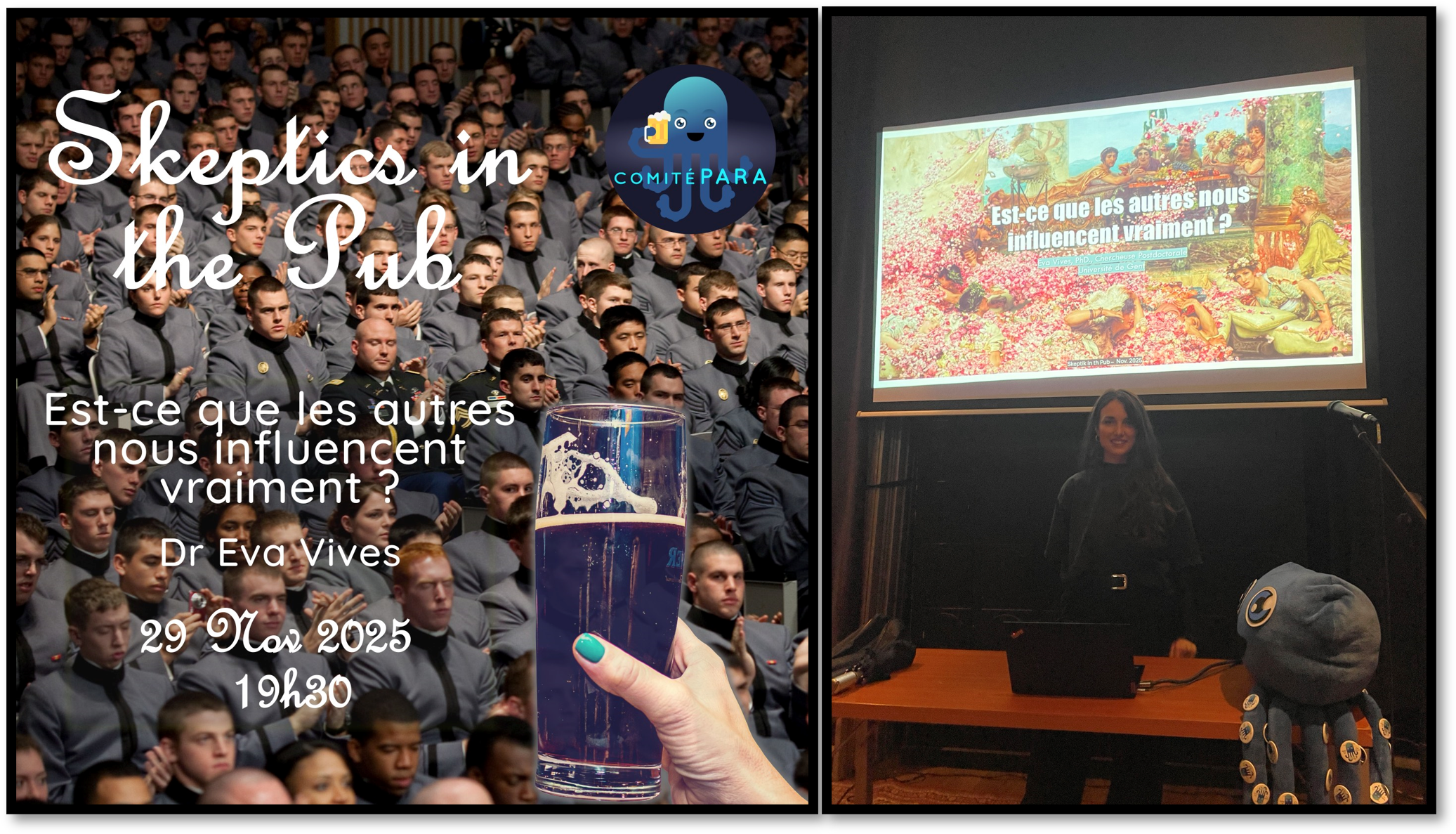
On November 29th 2025, I had the pleasure to talk about social presence effets at the Skeptics in the Pub event in Brussels. These events are devoted to share knowledge about science to general audiences. During the conference, I presented the different types of social influence identified in social psychoology and neuroscience, from mere presence to direct social interactions. We discussed the Triplett experiments with bikers, the ‘watching eyes’ effect and recent neurophysiological studies using hyperscanning technique to measure direct social interactions between people. And, of course, I also got the public to answer moral dilemmas live!
The video recording of my talk will be made available soon, stay tuned.
This is a slightly unusual post, that has been close to my heart for a long time.
As both a researcher and an internet user, data privacy and data storage have become increasingly crucial over the years. This concern is not only about protecting my own data (never forget: your online data are valuable), but also about ensuring the safety and confidentiality of research participants and collaborators.
There is no such world where you have ‘nothing to hide’, because our world is constantly changing, both culturally and politically. Spread the word.
Without commenting further on the current global situation, I simply wanted to share a few practical solutions that can help maintain at least some control over personal data.
⚠️ This list is of course non exhaustive as I am not an IT engineer and because everyone must consider which practices and tools are best for their own situation. My idea is to provide suggestions that might be useful or inspiring for your own setup. This post is a living document, intended to evolve over the years. Feedback and additional suggestions are very welcome
Communication Tools
🛡️ iPhone iMessage
One of the messaging services with very limited governmental access
Designed and controlled by Apple
Blocking iMessage would require blocking entire telecommunications systems, making it practically infeasible
🛡️ Email — Proton Mail
Strong focus on privacy and encryption
Allows the creation of temporary security keys when sending emails to non-Proton users (e.g., Gmail)
Example:
You send an email from Proton to a Gmail address
The recipient receives a secure link
The message is opened directly on Proton’s servers, not Google’s
🛡️ Instant Messaging
Olvid (Highly Recommended)
Unlike WhatsApp, Telegram, or Signal:
Each conversation establishes a direct link between users
No reliance on a centralized server nor cloud
Strong identity-based cryptography
Signal (Fallback Option)
Preferable to Meta-owned services
Important note:
Not linked to a phone number
Smaller ecosystem and better privacy guarantees than most mainstream alternatives
🛡️ Data Storage
Personal NAS (Network Attached Storage)
Strongly recommended for:
Personal file storage
Photos and videos
Secure file sharing
Advantages:
Full control over your data
No third-party cloud dependency
Can be set up in half a day
Final Thoughts
Privacy-respecting tools are not about paranoia, they are about responsibility, especially in research contexts. Small choices, when combined, can significantly reduce unnecessary data exposure.